top of page

The Ecological Dynamics Model for Aviation (EDMA)
A model for flight training design

Flight training is about more than mastering manoeuvres. It is about developing pilots who can adapt, perceive what matters, and respond safely when conditions change.

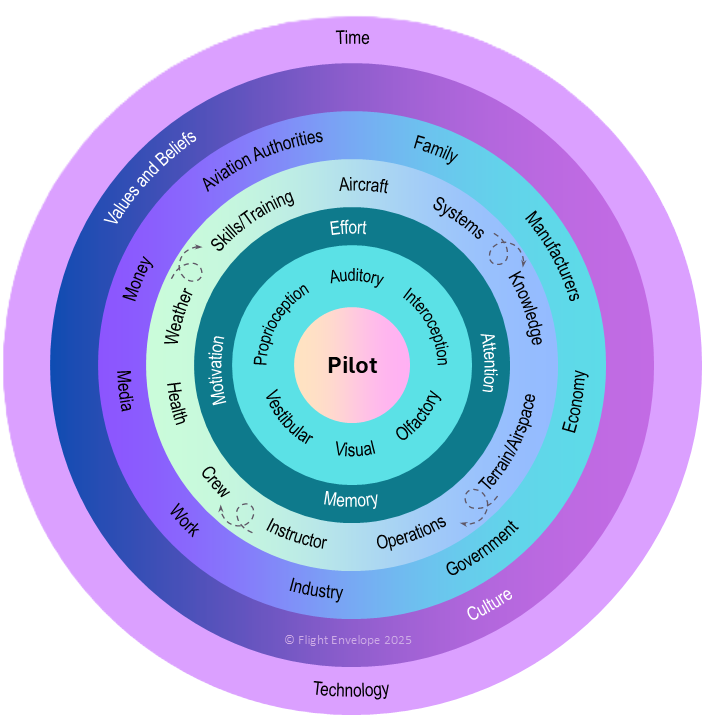
The Ecological Dynamics Model for Aviation (EDMA) is a nested systems model that provides general aviation with a coherent learning theory for flight training design. It treats flight learning as the emergence of adaptive skill within a layered system, where perception and action are continuously coupled under changing environmental, technical, emotional, and social conditions.

What EDMA Is

EDMA places the pilot at the centre of a series of concentric layers, each shaping what a pilot can notice, do, retain, and transfer:

  • Pilot: the learner at the centre

  • Perceptual systems: visual, auditory, vestibular, proprioceptive, olfactory, interoceptive

  • Cognitive-affective processes: effort, attention, memory, motivation

  • Operational environment: aircraft, instructor, crew, operations, terrain, airspace, skills and training

  • Ecological context: industry, government, culture, economy, values and beliefs

  • Time and technology: retention, skill decay, long-term skill development and effects of technology


The intellectual contribution is not the individual constructs, which are drawn from established research in ecological psychology, motor learning, and safety science. It is the synthesis: the specific architecture, the layer relationships, and the applied framework for aviation training design.

FE-EDMA-LOG-Whole Model no BG.PNG
Why EDMA Matters

General aviation training still relies heavily on procedural repetition and competency checklists. Those tools have value, but they do not fully match the conditions under which safe flight performance is actually produced.


Real flight requires:

  • Continuous coupling of perception and action under changing conditions

  • Retention across long gaps between flights

  • Transfer to unfamiliar situations

  • Safe adaptation when events depart from the script


Research from aviation, ecological psychology, motor learning, and safety science shows that these outcomes are not well served by narrow training designs built mainly around repetition of prescribed responses. EDMA offers a stronger foundation.

EDMA and the Nine Principles


EDMA serves as the educational bridge between the physical truths of flight and the pilot's ability to apply them. Rich Stowell's Nine Principles of Light Aeroplane Flying define what governs flight. EDMA explains how pilots develop the skill to operate within those principles through perception-action coupling. Where the Nine Principles describe what the aircraft does, EDMA addresses how the pilot learns to perceive it, respond to it, and retain that capability over time.

What EDMA Is Not

EDMA is a design framework. It does not prescribe specific flight procedures, operational limits, or airworthiness standards. It does not replace, override, or modify any regulatory requirements, approved training syllabi, or safety procedures issued by CASA, the FAA, or any other aviation authority.

All training decisions, safety assessments, and regulatory compliance remain the responsibility of the organisation or individual applying the model.

A Personal Reflection
Kristy How, Co-Founder


When I first applied what I knew about ecological dynamics to flight training, it felt like finding the missing piece of a puzzle. As both a teacher and a pilot, I had often observed a disconnect between theoretical knowledge and practical application and a failure to put the student at the centre of the learning process. Using the ecological model brought clarity to me where there seemed to be too many 'bolt-on' parts. It revealed why some students thrived while others struggled, and offered tools to bridge the gap. It helped understand why accidents aren't just a product of poor understanding.


One moment that stands out was at a workshop with a group of highly experienced instructors. Collectively, they represented  tens of thousands of flight hours. When asked what they wished their students understood, their responses were strikingly consistent: students' inability to grasp the implications of their actions, whether skipping study materials, failing to learn checks, or neglecting to use sufficient rudder.


It became clear that both students and instructors were missing a shared roadmap. Students wanted to learn but did not know how to learn effectively. Instructors struggled to connect their teaching to the student's perspective. Educational theory and design could provide the bridge. By aligning efforts and focusing on the how and why of learning, we could make flight training more effective, more engaging, safer, and even fun!

A Commitment to Lifelong Learning

​Whether you're a flight instructor looking to elevate your teaching or a pilot eager to grow, ecological dynamics offers something invaluable: a framework for continuous improvement. It’s about mastering not just the controls but the entire flying experience.

The Ecological Dynamics Model for Aviation (EMDA) is maintained under a stewardship model. It is availbale under a tiered licensing structure that allows wide access for research and education while preserving the model's integrity. 


Flight Envelope EDMA is a trade mark of Flight Envelope.

To find out about using and referring to the model follow the link below.

Community Aviation Logo sml
Read the Community Aviation Blog about the Ecological Dynamics Model
bottom of page